
What is a dry mortar plant?
A dry mortar plant or plant basically consists of a system of silos that allow the collection of raw materials (aggregates, cements, lime, additives, …) from where the dosage is carried out gravimetrically to a mixer, where carry out the mixture with the exact composition of the requested mortar.
Once produced, prior to its application on site, it can be used for bagging, temporarily storage or loading directly onto the truck that transports it.
Let’s take a closer look at the different capital goods that make up a manufacturing plant.
Useful link: PDF Catálogo planta de fabricación de mortero (ES, EN)
Machines and parts od dry mortar plant
1.Conveyors and unloaders
Conveyors and unloaders are the equipment that allow the raw materials be feed to the plant
The loading of cement, lime and filler, and in general all fines, is carried out by means of a pneumatic system, from the tanker truck that transports them.

The aggregates are loaded through a receiving hopper, where the trucks will unload, it transports it to a bucket elevator that lifts it to a distribution system made up of chutes, screens and screw conveyors that fill it classified in each silo.


2. Major raw materials silos (aggregates and cements)
The raw material silos will be in charge of housing each of the major components of the mortar, waiting for its dosage and mixing that will result in the finished product.
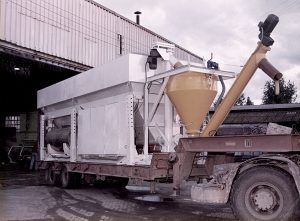
3. Additive silos
Like the majority components, additives are also stored in silos. Usually, 2 groups of silos are constituted, one with a greater capacity for the majority additives, and the other with a smaller capacity for the minority additives.
The loading of these silos is done manually, since the additives are normally purchased in sacks or big-bags.
4. Dosing system and material mixing
Since the raw materials stored process is finished, the operator selects the formula and the amount of material to be manufactured from the computer program, to which the corresponding formulation has previously been entered. This program will report in real time the status of the order, as well as the stock of raw material and finished product.
From each silo the material is dosed by means of screw conveyors to the scale hoppers, which in turn will discharge onto the mixer. Process that is carried out thanks to a dosing and weighing installation

In the case of additives, each of the silos has a micro-doser that is responsible for supplying the material in a controlled way to the precision scale patented by SOTECMA.

Once the weighing is done, the additive will be unloaded on a pneumatic transport system that will take it directly to the mixer.
When the mixer is filled with all the selected and weighed materials, the mixing process begins.

Once the mixing process is finished, the final product is ready for transport, silage or bagging.
5. Shipping and supply
Bulk supply
The mortar is supplied on site through a tanker truck that will unload the product into a silo placed to store it until its application. The mortar supplier will be in charge of supplying, together with the mortar, this silo and the water mixing equipment.

At the site itself, the product can be extracted from these silos in two different ways:
- By gravity, placing a mixer at the exit of the silo that will provide the water and make the mixture for immediate application. From here, you have to transfer the mixture made, to the working point.
- By pressure, in this case, the silo is pressurized and the dry mortar is pneumatically transported to the exact point of application, where it will be mixed with water with a portable mixer placed next to the working point.
Supply in big bags or bags
This is the most common way to supply the dry mortar, it is needed bagging machine and palletizer. By manual or automatic way.